Senior capstone · MAE 4188 · Team PLATH
3D-printed competition aircraft
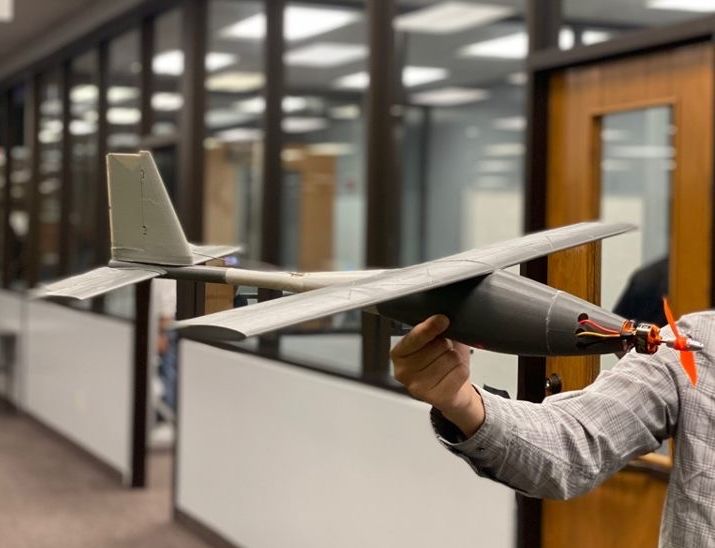
Our team designed, printed and flew a fixed-wing aircraft for the 6th Annual 3D Printed Aircraft Competition. The plane gets at most 8 seconds of powered launch, then has to stay airborne inside a 300 ft by 160 ft by 30 ft field. Every airframe part is 3D printed. Only the propeller and electronics are off the shelf.
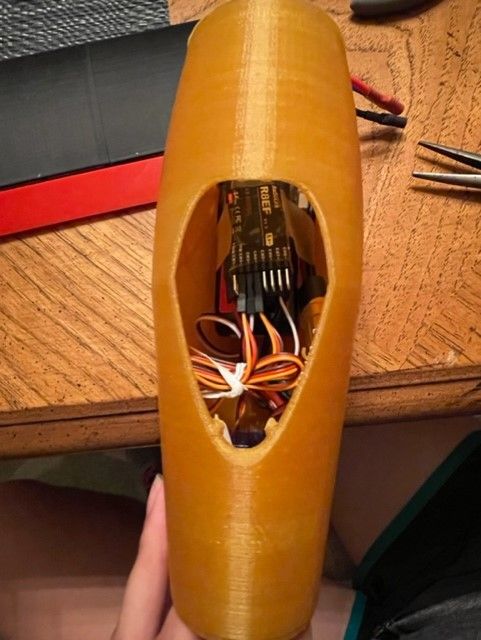
We started from a baseline glider, built the geometry in OpenVSP, then modeled it in SolidWorks. The wing uses a NACA 63-212 airfoil with an internal I-beam and rib structure sized by treating the wing as a cantilever beam. The tail uses NACA 0012. The airframe is printed in sections with ABS on FDM printers, and the electronics mounts are printed on an SLA printer.
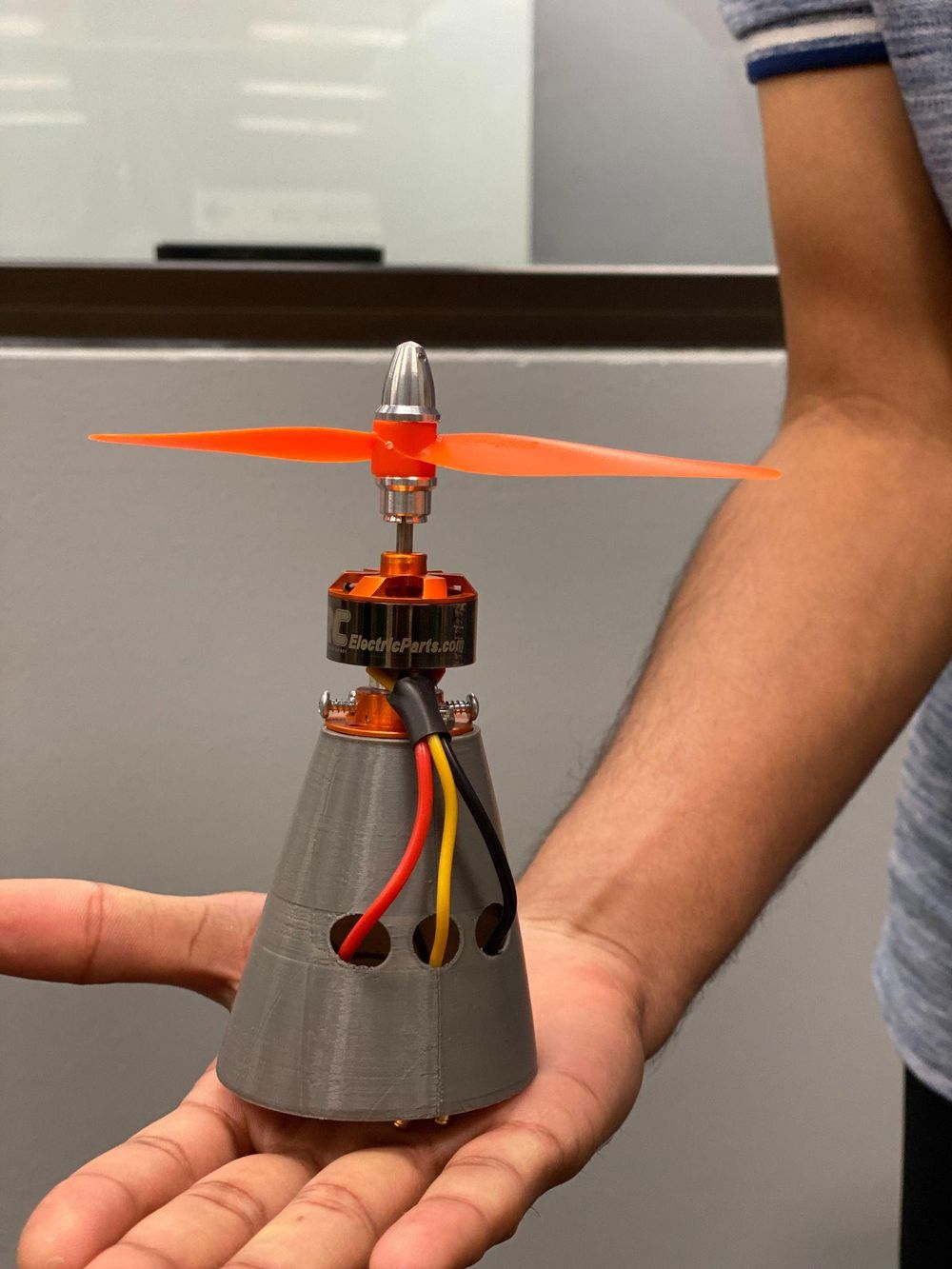
We built three prototypes. The second had weight, center of gravity and print quality problems, because parts came from several printers. For the third we cut about 80 g from the tail, removed a fuselage section to shorten the boom, redesigned the servo mounts and moved to a larger propeller. Flight tests still showed a lateral center of gravity offset and too little thrust, so we ran balance and wind tunnel tests on the next iteration.
Tools and methods OpenVSP · SolidWorks · FDM and SLA printing · Structural sizing · Flight testing
| Wingspan | 34 in |
| Fuselage length | 24 in |
| Wing airfoil | NACA 63-212 |
| Tail airfoil | NACA 0012 |
| Controls | Rudder, elevators |
| Power | Brushless motor, 2S 300 mAh Li-Po |
| Propeller | 12 × 6E, up from 7 × 4E |
| Static thrust (calculated) | about 0.9 lb to 7.7 lb |
| Print sections | 6 wing, 4 fuselage |
| Wall thickness | 2 bead (FDM), 1 mm (SLA) |